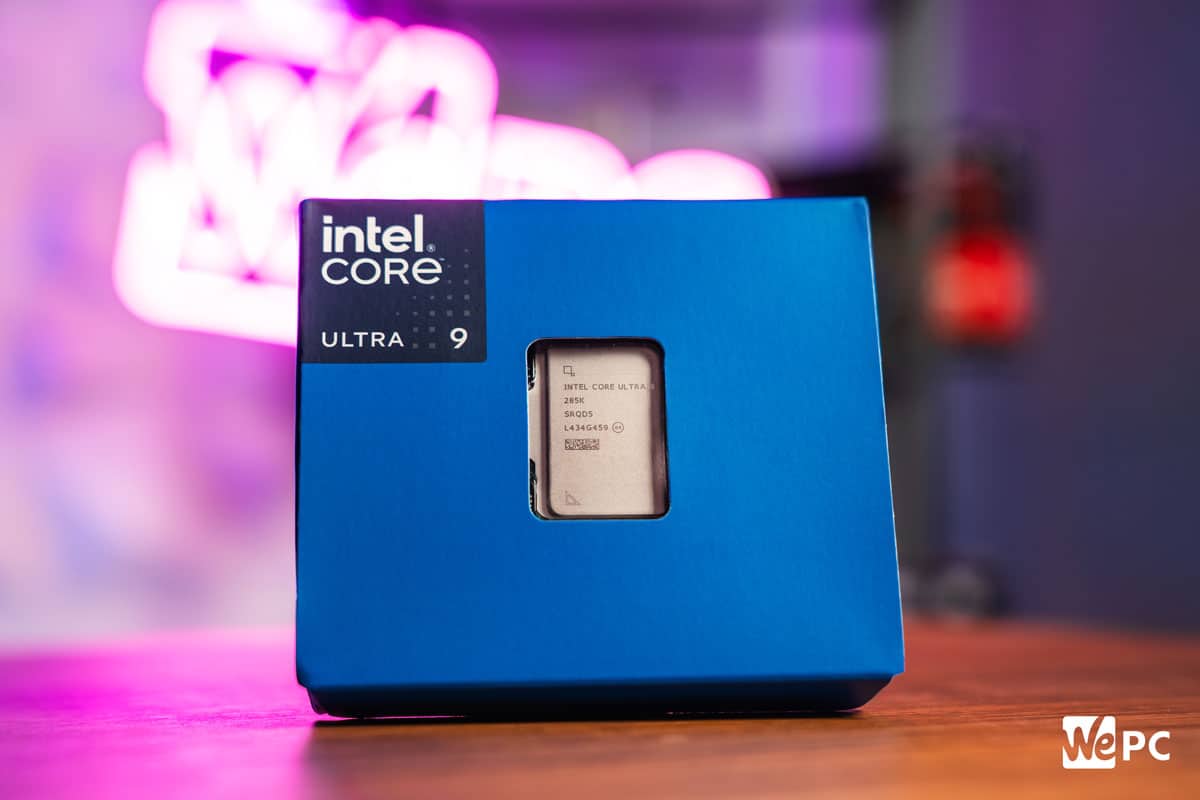
We pit Intel’s new Core Ultra 9 285K flagship CPU against the ever-popular Ryzen 9 9950X to see how they stack up in price, gaming performance, and heavy workload tasks – concluding with our thoughts on which you should buy.
The Core Ultra 9 285K is Intel’s new flagship Alder Lake CPU. It features many improvements and changes over its predecessor, delivering a decent generational uplift over the brand’s 14th-gen flagship. That said, Intel has made some unique tweaks to the Core 9 285K model, such as removing hyperthreading—a feature that has been with the brand for over 20 years now.
That said, what Intel lacks in hyperthreading it makes up for in generational productivity performance. If you’ve read our 285K review, you’ll know that the CPU still excels in heavy workload synthetics despite the lack of hyperthreading. While this is great for creatives and professionals running heavily threaded programs, it isn’t a necessity when it comes to gaming. Fortunately, gaming isn’t the focus of AMD’s flagship 9950X either – with AMD tailoring its soon-to-be-released 9000X3D CPUs for that demographic.
AMD’s Ryzen 9 9950X also targets the PC enthusiast marketplace, claiming generational IPC gains of around 16%. Unlike the Core 9 285K, the 9950X features hyperthreading support, making for an interesting battle when it comes to the synthetic portion of this comparison.
With that said, we have the makings for a very close fight between these two flagship processors. Let’s get into the specifications to see how they stack up on paper.
✓ Article Summary
At a glance
Intel Core Ultra 9 285K vs. Ryzen 9 9950X: Both CPUs bring competitive performance to the table, with Intel dropping hyperthreading for the first time in over 20 years, focusing instead on efficiency and productivity.
Gaming Performance: The Ryzen 9 9950X edges out the 285K in gaming, delivering slightly higher FPS in titles like CS2 and Doom Eternal. It’s the better choice for those looking to maximize every frame in the non-X3D series.
Productivity Strength: Intel’s 285K shines in multi-core tasks, outperforming the 9950X in benchmarks like Cinebench R23 and CPU-Z. Its 3 nm process and reduced power consumption make it ideal for those balancing gaming with heavy workloads.
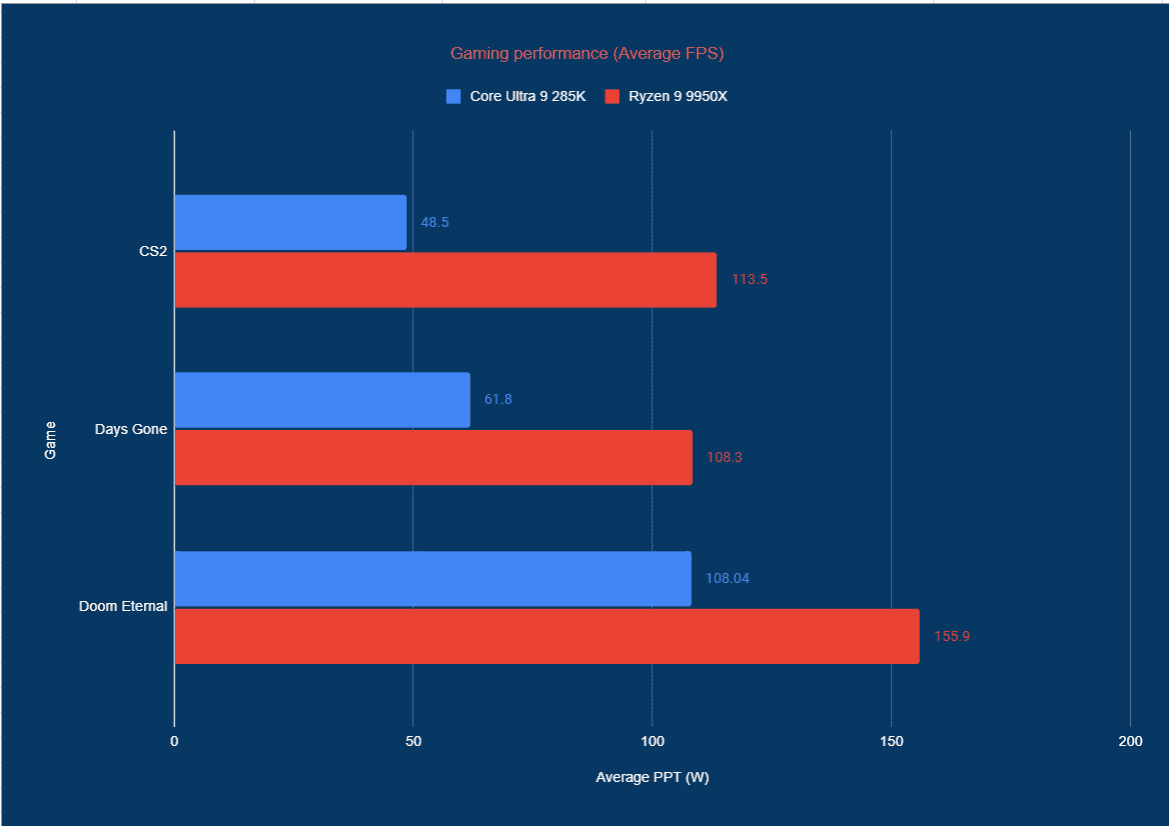
Power Efficiency: The Core Ultra 9 285K is more power-efficient, particularly in gaming scenarios where it uses as low as 48.5W in CS2 compared to the 9950X’s 113.5W. This makes it a cooler, quieter option for power-conscious users.
Platform and Future Considerations: While both CPUs are closely matched now, AMD’s upcoming 9800X3D is expected to set a new bar in gaming performance. Choosing between the 285K and 9950X depends on whether you need superior gaming performance now or a balanced, power-efficient system.
Specifications
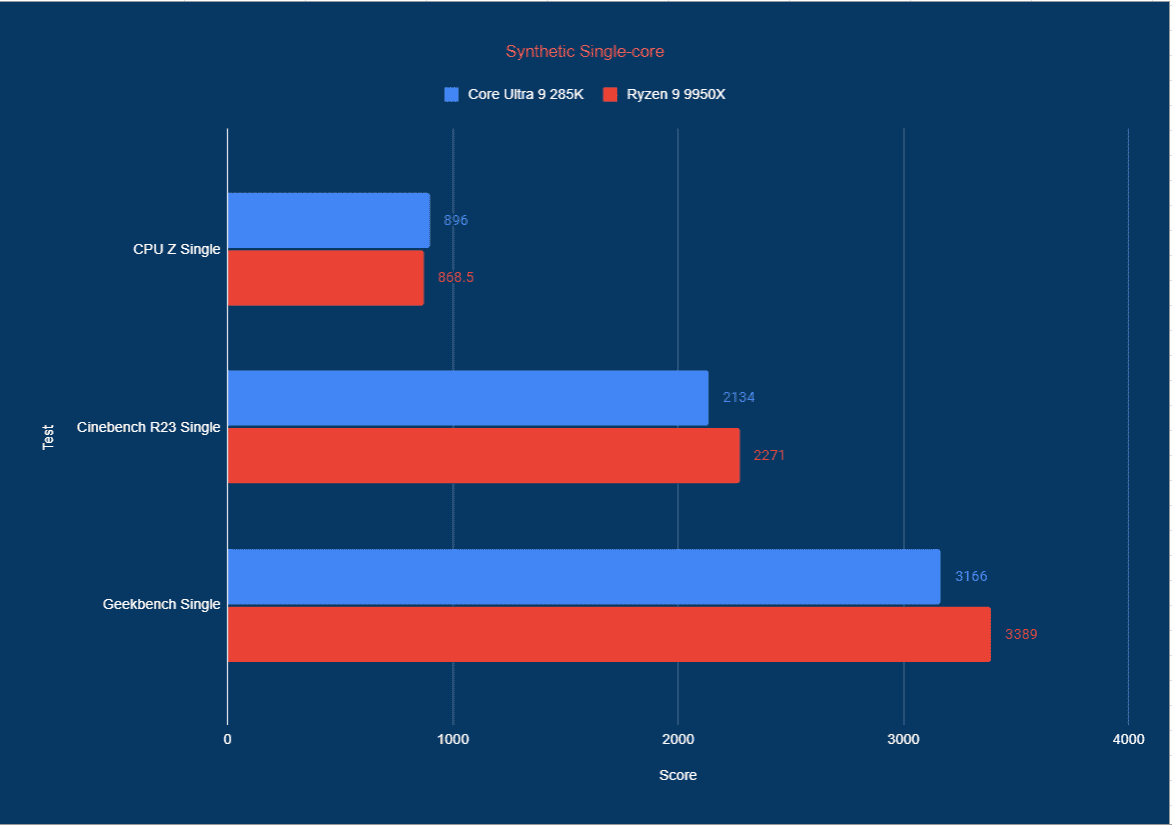
On paper, these two CPUs seem very close. While there’s a constant give and take that seems to even out overall, we feel Intel’s shift to the 3 nm process is well worth highlighting – with AMD only featuring 4 nm transistors. That said, we can’t help but feel like Intel should be doing a lot better on the single-core performance front, especially when you factor in the brand’s history in this department.
The most notable change is, of course, the lack of hyperthreading on the Intel CPU. Hyperthreading has been a staple of Intel CPUs for over 22 years and it’s strange to see an equal number of cores and threads from Team Blue. Without giving anything away, we were impressed with how well it managed to keep up despite the 8 thread deficit.
Component
Core Ultra 9 285K
Ryzen 9 9950X
Cores
24
16
Threads
24
32
Hybrid architecture
P-core: 8 E-core: 16
N/A
Base frequency
P-core: 3.7 GHz E-core: 3.2 GHz
4.3 GHz
Boost frequency
P-core: 5.5 GHz E-core: 4.6 GHz
up to 5.7 GHz
Memory speed
6400 MT/s
5600 MT/s
PCI Express lanes
20 (Gen 5)
24 (Gen 5)
L2 cache
3 MB (per core)
1 MB (per core)
L3 cache
36 MB (shared)
64 MB (shared)
TDP / PL1 / PL2 / PL2 (extreme)
125W / 250W / 250W / 295W
125W / 230W / 230W / 230W
Process size
3 nm
4 nm
Socket
LGA 1815 (compatible with Z980)
LGA 1718 (compatible with X870, X670, B650, A620)
Core Ultea 285K vs 9950X specifications
Bear in mind, that when we tested the 285K, we were on pre-release drivers BIOS’ – meaning this performance could have changed drastically since we tested the CPUs. But we highly doubt that. It’s not like we’re expecting to see Intel increase the TDP of its processors post-launch (we’re looking at you, AMD).
That said, let’s jump into the testing and performance section of this comparison to see how the chips stack up in real-world scenarios.
Performance
We tested the 285K against the 9950X in a variety of both synthetic and real-world workloads. The synthetics include CPU-Z, Cinebench R23, and Geekbench 6. For real-world tests, we used CS2, Days Gone, and Doom Eternal. All of the games tested were done so in 1080p at LOW settings to try and isolate the processing performance of the chips.
Benchmarking rig
To keep things as fair as possible, we tested the two CPUs on as similar rigs as possible, following our how we test CPUs methodology. Here are all the components that we used when testing the two flagship beasts:
Component
Name
CPU
Intel: Intel Core Ultra 285K / AMD: Ryzen 9 9950X
Cooler
Corsair H150i Elite LCD
Motherboard
Intel: ASUS Maximus Hero Z890 / AMD: ASUS Crosshair X870 Hero
Memory
Corsair Dominator Platinum DDR5 @6800 MHz
GPU
MSI RTX 4070 Ti
PSU
ASUS Thor Platinum II 1000W
Case
Cooler Master Masterframe
WePC test bench components
Performance benchmarks
285K vs 9950X gaming performance
285K vs 9950X review synthetic multi core
285K vs 9950X review synthetic single core
285K vs 9950X power consumption
Previous
Next
1 of 4
Previous
Next
In a head-to-head match between the Core Ultra 9 285K and Ryzen 9 9950X, both CPUs bring their strengths to the table – with few notable differences across gaming, synthetic benchmarks, and power efficiency. Let’s dive into the highlights of our benchmarks.
Gaming performance leans slightly in favor of the Ryzen 9 9950X. It edges out the 285K in most titles, like CS2 (where it hits 323.7 FPS against 313.8 FPS for the 285K) and in Doom Eternal (with 507.6 FPS compared to 499.8 FPS). While these differences won’t drastically alter your gaming experience, the 9950X’s consistency in high-FPS scenarios might make it the go-to if you’re aiming to squeeze every last frame out of your CPU.
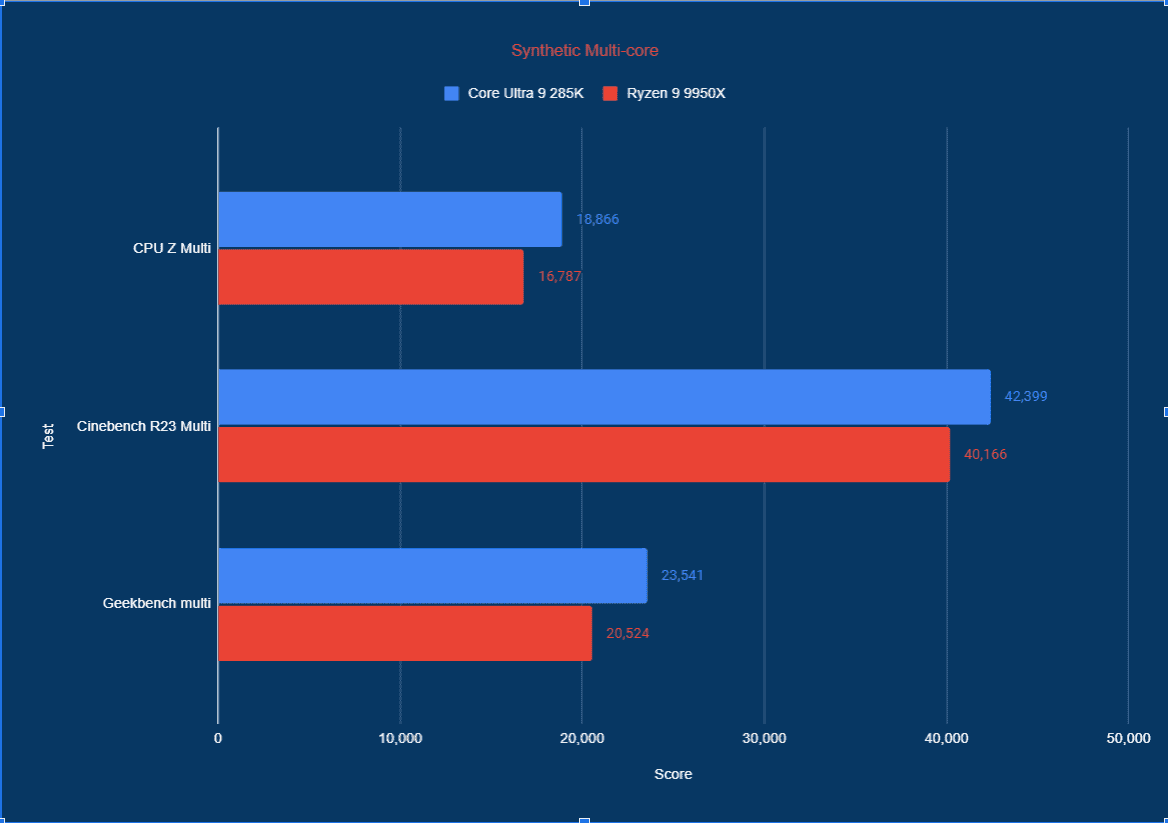
On the other hand, synthetic benchmarks tell a different story. The 285K pulls ahead in multi-core tests like Cinebench R23 (scoring 42,399 compared to the 9950X’s 40,166) and in CPU-Z Multi (where it manages 18,866 over 16,787). For multi-threaded workloads, content creation, or heavy rendering tasks, Intel’s latest flagship proves it’s got some serious muscle – and it does so without hyperthreaded CPU cores.
285K vs 9950X review gaming performance FPS
Perhaps the most striking difference, however, is in power consumption. The Core Ultra 9 285K runs far more efficiently, particularly in gaming loads. In CS2, it sips just 48.5W compared to the Ryzen’s 113.5W. Even in games like Doom Eternal, it leads in efficiency, consuming around 108W while the Ryzen pulls 155.9W. That could mean a cooler, quieter system overall if you go with Intel. Just bear in mind, that you’ll have to upgrade your motherboard as well if you are planning the Intel upgrade.
Ultimately, it’s a trade-off between raw gaming power and all-around efficiency. The Ryzen 9 9950X edges out in gaming framerates, but the Core Ultra 9 285K offers better power management and multi-core strength – making it a versatile pick for those who need their rig to handle more than just gaming.
Should you wait for the 9800X3D?
If you’re looking at the 9950X, thinking it’s the most attractive gaming option on the market, you might want to pick up the 9800X3D instead. It lacks the cores and raw power outside of gaming, but the X3D cache has proven it can lay waste to any other CPU when it comes to gaming workloads. Though it isn’t out yet, if you want a true gaming PC, the 9800XD will most likely perform better than the 9950X in games and hit shelves at a lower MSRP.
Are there any platform differences?
The great thing about opting for the current generation of hardware is you essentially get the same thing on both sides, and this time around it’s no different. You can essentially think of the separate chipsets (X870 and Z890) as just different vessels on which to host your CPU of choice – no matter which you pick, you’re at no clear disadvantage.
When looking at top-end models for both chipsets, users can expect PCIe Gen 5 support (for both the GPU and storage), USB 4, and WiFi 7. For budget options, these features may vary. That said, it has to be said that the Z890 motherboards tend to host faster memory speeds than the X870 – as the ASUS Strix Z890 A demonstrates:
ASUS Strix X870 DDR5 speedASUS Strix Z890 DDR5 speed
Same motherboard, just different chipsets. Source: ASUS webpage for respective motherboards.
Final word: which CPU is better
The comparison between Intel’s Core Ultra 9 285K and AMD’s Ryzen 9 9950X is a close call, each excelling in different areas. The 9950X takes the lead in gaming performance, consistently delivering slightly higher frame rates in titles like CS2 and Doom Eternal – which might appeal to gamers seeking every possible FPS edge. However, Intel’s 285K stands out in efficiency, especially with its lower power consumption in gaming scenarios – showcased by its impressive 48.5W draw in CS2 compared to the 9950X’s 113.5W. Intel’s focus on a 3 nm process and strong multi-core performance also gives it an edge in productivity tasks, despite the lack of hyperthreading.
While the Ryzen 9 9950X is a solid choice for those prioritizing gaming performance right now, the potential release of the 9800X3D looms large, promising a more focused gaming powerhouse with the X3D cache. Meanwhile, Intel’s 285K caters to those who need a balance of work and play, offering robust performance in productivity tasks without falling too far behind in gaming. Ultimately, the choice between these two comes down to what you need from your system and whether you’re looking for that extra FPS in games, or lower power consumption and multi-threaded strength in everyday use.
Jack is a Tech and News Writer who has a vast and proficient knowledge of CPUs, Motherboards, and Computer technology.
Trusted Source
WePC’s mission is to be the most trusted site in tech. Our editorial content is 100% independent and we put every product we review through a rigorous testing process before telling you exactly what we think. We won’t recommend anything we wouldn’t use ourselves. Read more